
Preparing Your Home’s Windows & Doors for Winter in Enterprise
Enterprise’s average January low is 34°F, which sounds harmless until you realize aluminum window frames start conducting cold at 32°F. Your HVAC system then compensates silently, adding $40-$90 to your bill every month you ignore the gap. The mild climate here makes it easy to skip winter prep entirely – and that’s exactly why one cold snap to 28°F catches aluminum frames, worn weatherstripping, and failing threshold seals completely off guard.
Here’s the good news: six specific checks take under two hours and cost under $40 in materials. If you’d rather not spend a Saturday afternoon on it, call (866) 616-0837 and we’ll take a look.
Why Enterprise Homeowners Skip Winter Window Prep (And Why That’s a Mistake)
Most people in Enterprise treat winter prep as something homeowners in Reno or Tahoe worry about. Fair enough on the surface. But the thermal dynamics in the Las Vegas Valley work against you in a quieter way. Aluminum frames – common in the ranch-style homes built across Enterprise in the 1990s and 2000s – have no thermal break. That means the metal transfers outside cold directly to the inside of the frame. You don’t see drafts. You see a slowly climbing gas bill.
We’ve measured surface temperatures on aluminum frames in Enterprise on a 38°F morning and found interior sill temps running 8-12°F colder than the room. The HVAC system doesn’t flag it. It just runs longer. Over a full season, the Department of Energy estimates 15-25% of heating energy is lost through poorly sealed windows and doors.
That’s the case for two hours of prep work. It’s not glamorous. It’s just cheaper than paying the utility company a premium for air you’re not keeping.
Key Takeaways
- Aluminum frames begin conducting cold at 32°F, even though Enterprise rarely drops that low.
- Prep work runs under two hours and costs under $40 in materials from local hardware stores.
- Sliding glass door tracks in fall collect debris that blocks full closure all winter.
- Frame condensation is your earliest warning sign of a failed thermal break.
- Some findings mean the repair is beyond DIY – we’ll tell you honestly when that’s the case.
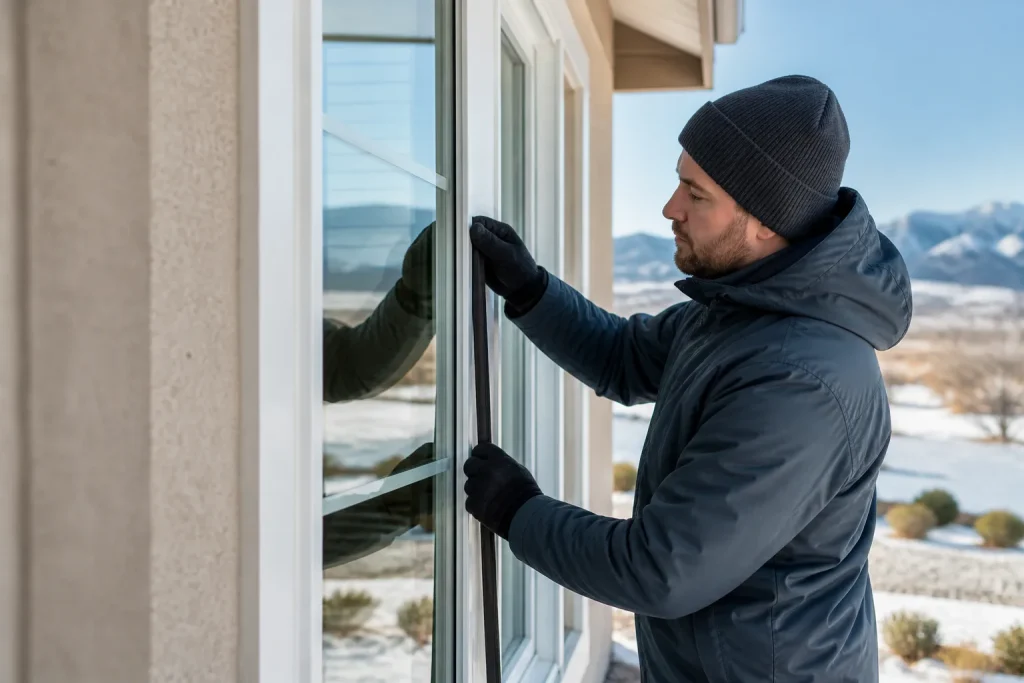
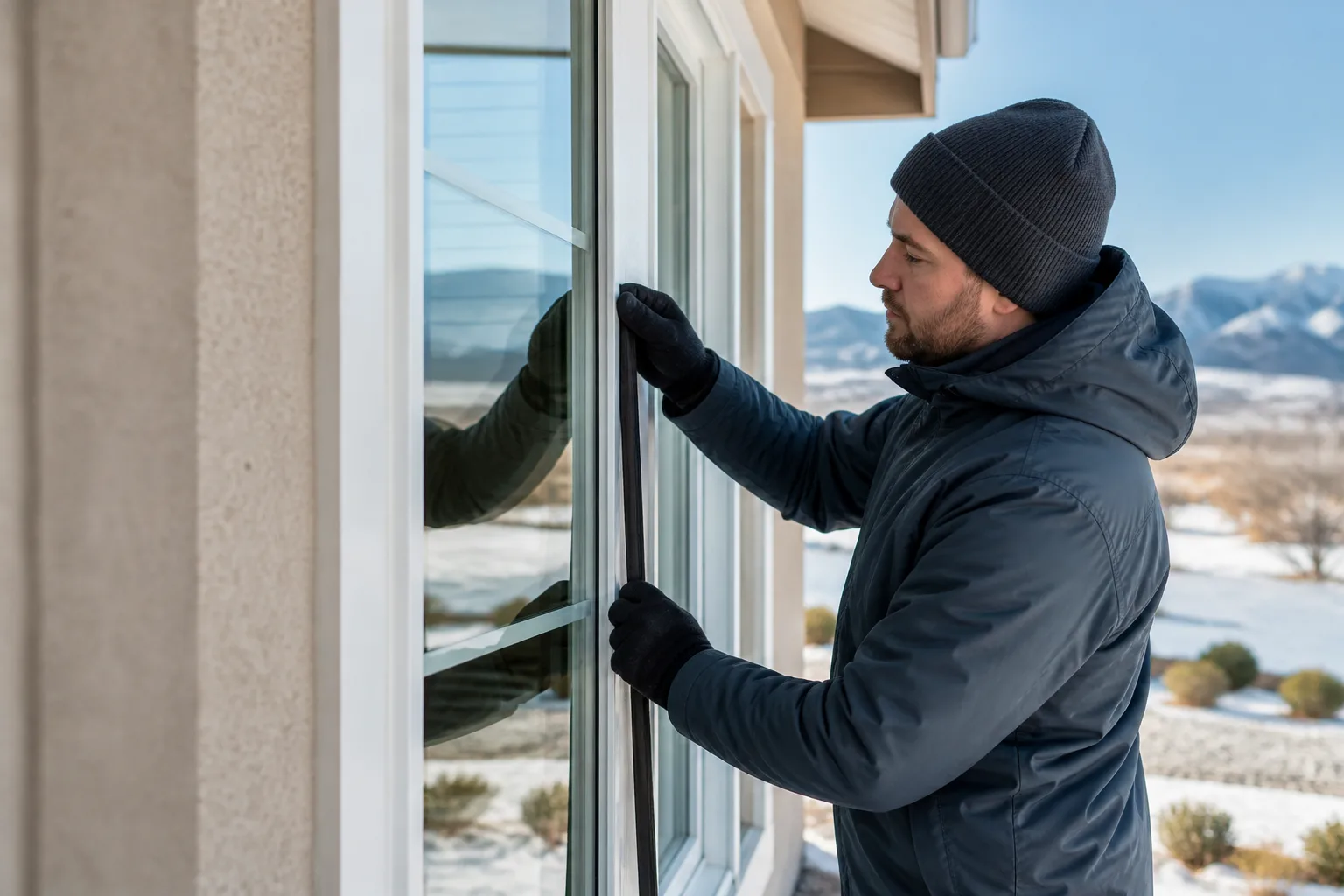
Check 1: Match the Right Weatherstripping to the Right Gap (Costs $6-$18)
Weatherstripping is not one product. Walking into a Las Vegas hardware store and grabbing the first roll you see is how people end up frustrated by spring. Match the material to the application:
- V-strip (tension seal), $10-$15 per 17-foot roll: Best for the vertical gaps on double-hung and casement windows. The V-shaped vinyl or bronze strip compresses when the window closes and expands into the gap. Bronze V-strip, while pricier, handles heat better in East-facing windows that bake in summer.
- Foam tape, $6-$10 per roll: Fits sliding windows and sliding door jambs where the gap is uniform. Avoid foam in any spot exposed to direct sun – it degrades fast in Valley heat and won’t make it to next season.
- Door sweeps, $15-$25 each: The under-door gap on front and back doors is the single biggest cold-air point in Enterprise homes. Choose a sweep with a flexible vinyl bulb (not a brush style, which wears out on rough thresholds).
- Felt strips, $4-$8 per roll: Fine for interior airtightness between seasons but they don’t survive sun or rain. Don’t install felt on any exterior door in Enterprise.
Check every operable window and door in the house. Most Enterprise homes need 30-40 feet of material across all openings – under $35 total.
Check 2: Test for Frame Condensation Before Water Damage Starts
Condensation is your early warning system. If you see moisture on the interior side of a window frame, that tells you the frame’s thermal break has failed. The thermal break is a non-conductive barrier built into better-quality frames that stops cold from traveling through the metal. When it fails, you get condensation first, then – if you ignore it across seasons – bubbling paint, softening drywall below the sill, and eventually mold in the wall cavity.
The test takes three minutes per window:
- On a cold morning (below 45°F), run your hand along the interior frame. If it feels noticeably colder than the surrounding drywall, that’s a failed break.
- Look for water beads or a whitish haze on the glass near the frame edge. That haze is calcium from repeated condensation.
- Hold a strip of toilet paper near the closed window seam on a windy day. If it flutters, you have an air leak somewhere in that assembly.
If two or more windows fail these checks – especially on the north and west sides of an Enterprise home – the frames themselves are the problem, not the weatherstripping. That’s a replacement conversation, not a prep one. Our Window Repair in Enterprise team handles assessment so you know exactly what you’re dealing with.
Check 3: The Three-Minute Threshold Inspection
This is the most-skipped and most-important check for Enterprise ranch-style homes. The threshold assembly – the sill plate, door sweep, and adjustable threshold cap – is typically the largest source of cold-air infiltration in these layouts, because the door faces a wide-open front yard with no windbreak.
Stand inside with the door closed and the lights off. On a cold evening, look at the bottom edge of the door for daylight. If you can see light, cold air is coming through. Then check:
- Sweep contact: The sweep should touch the threshold along its full width. A gap of more than 1/16 inch needs adjustment.
- Threshold cap wear: Wood thresholds in Enterprise dry out and split. A split cap can’t seal no matter how good the sweep is.
- Adjustable threshold height: Many thresholds have a screw-adjust feature. Turning it up a quarter-turn sometimes closes the gap without any new materials.
If the threshold itself is failing, a front door replacement with a properly-sealed Therma-Tru system is often more cost-effective than chasing a fix on a 20-year-old door. We’ve pulled doors out of garages in Enterprise where the threshold was so thin at the base it had essentially given up – no weatherstripping in the world would have closed that gap.
Check 4: Clean the Sliding Glass Door Track (The Method That Actually Works)
Sliding glass doors are common in Enterprise homes, and their bottom tracks collect leaf litter, dust, and the fine sand that blows in from the surrounding desert all fall. That debris hardens into a crust that prevents the door from rolling fully closed – all winter long. You’ll push it shut. It feels shut. And you’re still leaking air.
Here’s what works:
- Vacuum the track dry with a narrow nozzle before you get it wet. Wet debris becomes paste and jams the rollers.
- Spray a 50/50 mix of white vinegar and water into the track. Let it sit for five minutes.
- Scrub with an old toothbrush – not a wire brush, which scratches the aluminum and gives debris a fresh home next season.
- Wipe dry with a rag, then run a dry bar of soap along the inside of the track. That thin film keeps rollers gliding without attracting grit.
- Roll the door open and closed three times and check for uniform travel. If the door hesitates or you see the roller jump the track, the rollers themselves may need replacement.
A five-minute cleaning prevents a full winter of cold-air infiltration through a half-closed door. If the rollers are shot or the door glass has lost its seal, our team can walk through the options with you.
When to Call a Pro: When Prep Turns Into Repair
Prep work is worth doing. But some findings are beyond DIY, and it’s a mistake to ignore them. Call in a professional when:
- Two or more windows fail the condensation test, or you see actual water damage (soft drywall, bubbling paint, staining) below any sill.
- The threshold or door frame itself is cracked, rotted, or bowed. Weatherstripping can’t fix a structural gap.
- Sliding door rollers are worn out or the door no longer rolls true in its track.
- You find air leaks at the frame-to-wall joint. That’s a caulking-and-reflashing job, not a weatherstrip one.
A written professional assessment in Enterprise typically runs $75-$150, and it should include a line-item breakdown of what’s failing and what the repair would cost. Nothing in our trade should begin before you see that price in writing. When you’re ready to move to replacement, our Window Replacement in Enterprise and Front Door Replacement in Enterprise teams both install professional-grade lines – PGT, Therma-Tru, and ViewLux among them – matched to your home rather than pushed by brand. For glass-only issues, Mr-Glass options often cover what you need without a full replacement.
The Bottom Line
Winter prep in Enterprise takes a Saturday morning: check your weatherstripping types, test for condensation, inspect every threshold, and clean the sliding door tracks. Under $40 in materials and under two hours of your time can keep 15-25% of your heating energy in the house all season.
And when a check reveals something that isn’t a prep fix – failed thermal breaks, cracked thresholds, worn sliding door hardware – a written assessment tells you exactly what you’re facing before anyone picks up a tool. If you’re in Enterprise and need help, Hale Windows & Doors Enterprise offers free estimates – call (866) 616-0837. Every repair is covered by our written guarantee (free second visit if it fails), and every job carries the 365-Day Done Right Promise. If it’s not right, we make it right. Every technician arrives background-checked, identity-verified, photo-badged, and announced by name and photo before the visit, so you know exactly who’s at your door.
Related: if your prep inspection turns up a window past saving, start with our Hale Windows & Doors Enterprise home page to see how we handle replacement from assessment to installation.
Frequently Asked Questions
DIY prep runs $25-$40 in materials: V-strip weatherstripping ($10-$15 per roll), foam tape ($6-$10), door sweeps ($15-$25), and cleaning supplies. A professional assessment, if you want eyes on your windows before you commit, typically costs $75-$150 in the Enterprise market – and that assessment should include a written line-item price. Call (866) 616-0837 for a free estimate; we put the price in writing before any work begins.
Yes, because mild is what makes it easy to skip – and aluminum frames begin conducting cold at 32°F, which Enterprise drops below most winters. The result is a silent 15-25% heating energy loss. The prep work is cheap; ignoring it is not.
Two signs: interior frame surfaces that feel noticeably colder than the surrounding wall on a cold morning, and condensation forming on the inside of the frame. If multiple windows show both, the frames themselves are the source of your heating loss and it’s time for a professional assessment. Call (866) 616-0837 and we’ll walk you through what we find.
You can, and plenty of Enterprise homeowners do – but a towel under the door doesn’t seal the sides or top, and it blocks air without stopping the cold conduction that comes through the door panel itself. A proper door sweep plus adjusted threshold costs $15-$25 and works all winter without daily fiddling. If the door itself is the problem, our team can quote a replacement front door system.
Written by the team at Hale Windows & Doors Enterprise.
Need Windows & Doors Help?
Call Hale Windows & Doors Enterprise - licensed & insured, here with fast after-hours help in Enterprise.
(866) 616-0837